Master the critical frameworks to manage risk, eliminate bias, and ensure regulatory compliance when deploying artificial intelligence for modern fraud investigations.
AI is now embedded across fraud detection, financial crime monitoring, and internal investigative workflows, shaping how organisations identify anomalies, prioritise alerts, and assess evidence. However, these systems also introduce new forms of risk that traditional fraud controls were not designed to manage — including opaque model behaviour, biased or incomplete training data, synthetic or manipulated inputs, and automated outputs that may be difficult to explain or defend under regulatory or legal scrutiny.
This session examines the practical realities of using AI in fraud detection and investigations, focusing on how professionals can evaluate system reliability, challenge automated outputs, and maintain defensible investigative processes. It also explores how emerging governance frameworks — including the NIST AI Risk Management Framework, ISO/IEC 42001, and the EU AI Act — are shaping expectations around transparency, oversight, documentation, and accountability in AI-driven decision-making environments.
Key Topics Discussed

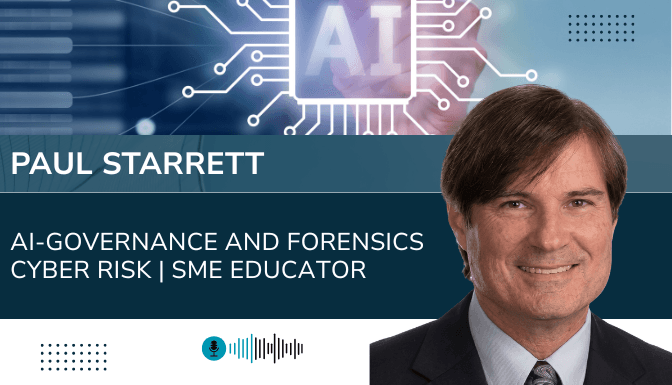
AI-governance and Forensics | Cyber Risk | SME Educator
My name is Paul Starrett and I am here to assist the investigative community in whatever way I can! I have just the right background to do so. I am a licensed private investigator and attorney who has performed thousands of interviews on major cases over a period of decades. I also have an exceptional technical background (prior engineer with a technical master’s degree). I am a Certified Fraud Examiner (CFE). I am the author of the Investigative Interviewer's Guidebook, now in its 25th year of publication. Previously, this book was used as a college text for decades. You may purchase it from the Home page.
Provincial regulators of CPAs in Canada do not require that independent providers of CPD be approved to offer courses. Instead, individual CPAs are responsible for assessing whether a CPD activity meets their requirements, and may take activities from any source provided those requirements are met.
Every course offered on LearnFormula is delivered by a qualified subject matter expert or learning organization, and advances learning objectives that are relevant to the responsibilities or professional competencies of Canadian CPAs. All activities on LearnFormula are quantifiable in terms of hours, and are also verifiable, in that users receive documented evidence of their attendance via a certificate of completion after finishing a course (and this certificate is stored by LearnFormula indefinitely). Nearly 100,000 Canadian CPAs successfully satisfy their CPD requirements via LearnFormula on an annual basis.
