Uncover the truth in any conversation by mastering the psychological, verbal, and nonverbal cues needed to spot lies, read hidden motives, and protect yourself from manipulation.
Effective communication often depends on the ability to assess credibility, identify inconsistencies, and respond strategically in high-stakes conversations. Detecting Deception within Interpersonal Communication introduces participants to practical, research-informed techniques for recognizing deceptive behavior in real-time interactions. Drawing from psychology, behavioral analysis, and investigative interviewing practices, this webinar explores verbal and nonverbal indicators of deception, cognitive load cues, and the role of baseline behavior in assessing credibility. Participants will also learn targeted questioning techniques designed to elicit more reliable information while avoiding common misconceptions about deception “tells.” Ideal for investigators, legal practitioners, managers, counselors, and other professionals who rely on accurate communication and informed decision-making.
Key Topics Discussed:

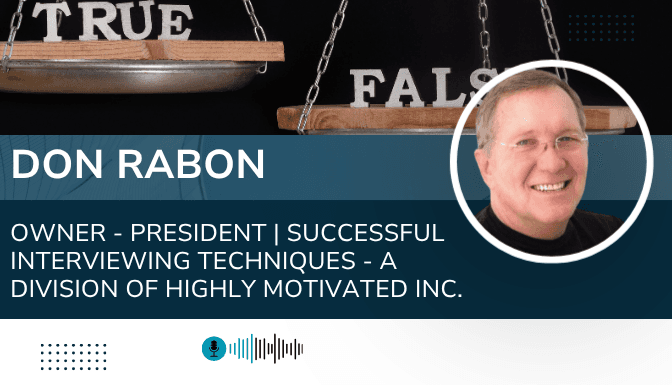
Owner - President | Successful Interviewing Techniques - a Division of Highly Motivated Inc.
Don retired as Deputy Director Western Campus, North Carolina Justice Academy, and was formerly manager of the Investigations Center of the North Carolina Justice Academy. Don has law enforcement experience in rural and municipal law enforcement agencies and instructional areas including Interviewing, Detecting Deception, Rapport Building, Interrogation, Persuasion, Audit-Related Interviewing, Investigations, and Investigative Discourse Analysis. For over a period of 35 years, his interviewing instruction and investigative assistance has been provided to related professionals in 46 U.S States as well as Puerto Rico, The Virgin Islands, Belgium, France, Germany, Australia, New Zealand, Canada, Trinidad, Barbados, Singapore, Ireland, and England. In addition, he has provided training to Federal, State, and Local Criminal Justice Personnel, NATO Counterintelligence Personnel as well as private sector investigative and corporate security personnel. Don has his A.A.S. in Criminal Justice, from Davidson County Community College and a B.S. in Criminal Justice Administration, from East Tennessee State University. He has performed advanced studies at Eastern Kentucky University and has military experience with the US Army. He is a published author of 4 texts: Interviewing and Interrogation 2nd edition; Investigative Discourse Analysis 2nd Edition; Persuasive Interviewing; Fraud Related Interviewing and is editor of the interviewing focused newsletter, Hamlet’s Mind.
Provincial regulators of CPAs in Canada do not require that independent providers of CPD be approved to offer courses. Instead, individual CPAs are responsible for assessing whether a CPD activity meets their requirements, and may take activities from any source provided those requirements are met.
Every course offered on LearnFormula is delivered by a qualified subject matter expert or learning organization, and advances learning objectives that are relevant to the responsibilities or professional competencies of Canadian CPAs. All activities on LearnFormula are quantifiable in terms of hours, and are also verifiable, in that users receive documented evidence of their attendance via a certificate of completion after finishing a course (and this certificate is stored by LearnFormula indefinitely). Nearly 100,000 Canadian CPAs successfully satisfy their CPD requirements via LearnFormula on an annual basis.
