Explore how AI is reshaping music and accounting, and learn how to use it wisely to enhance client confidence, protect your reputation, and elevate business performance.
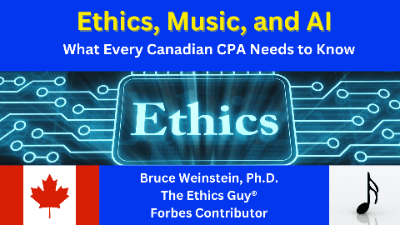
This course, "Ethics, AI, and Music: What Every Canadian CPA Needs to Know," explores the critical ethical considerations at the intersection of artificial intelligence, the music industry, and the accounting profession.
The rapidly evolving landscape of AI requires a strong ethical framework to make sense of it all. This distinctive program introduces five time-tested principles of ethical intelligence, beginning with Do No Harm, and shows you how to apply these principles both in your appreciate of music and in your accounting practice.
You will learn to:
Through engaging stories, real-world Canadian examples involving companies like Tim Hortons, Cadillac Fairview, and Air Canada, and even musical analogies, this course unpacks how using ethical intelligence in your work as a CPA is both the right thing to do and the smart thing to do too.
We'll examine why rigorous independent verification is crucial when using AI-generated materials and how to choose AI platforms that prioritize data security and consent (e.g., SOC 2 compliance).
This distinctive interactive session will help you make the best possible decisions in the coming years as you consider how to make wise use of AI and avoid the pitfalls that this technology presents to even the most conscientious CPAs.

Forbes Contributor The Ethics Guy®
Through his entertaining presentations on ethical leadership and AI ethics, Forbes Contributor Bruce Weinstein, The Ethics Guy, shows CPAs, HR managers, and other professionals how everyone benefits from honest, accountable behavior. He is the CEO of both The Institute for High-Character Leadership, LLC and The Ethics Guy, LLC. He writes about ethical leadership for Forbes.com, and his books include "Ethical Intelligence: 5 Principles for Untangling Your Toughest Problems at Work and Beyond," "The Good Ones: Ten Crucial Qualities of High-Character Employees," and for tweens and teens, "Is It Still Cheating If I Don't Get Caught?" Bruce's clients have included the international bank Societe Generale, the American Institute of Certified Public Accountants, the Ford Motor Company, Dublin-based construction company CRH, Northrop Grumman, the National Football League, the Western Australian Local Government Association, The Home Depot, and over 300 other companies around the world. Bruce received his B.A. in philosophy from Swarthmore College and an M.A. and Ph.D. in philosophy with a concentration in bioethics from Georgetown University and the Kennedy Institute of Ethics. The W. K. Kellogg Foundation in Battle Creek, Michigan awarded Bruce a National Fellowship in Leadership Development. He lives in New York City with his wife Kristen Bancroft, a compliance professional in the financial services industry. To relax Bruce enjoys playing music (guitar, harmonica, and drums), visiting national parks with his wife, and trying to figure out the plot of "The Godfather."
Provincial regulators of CPAs in Canada do not require that independent providers of CPD be approved to offer courses. Instead, individual CPAs are responsible for assessing whether a CPD activity meets their requirements, and may take activities from any source provided those requirements are met.
Every course offered on LearnFormula is delivered by a qualified subject matter expert or learning organization, and advances learning objectives that are relevant to the responsibilities or professional competencies of Canadian CPAs. All activities on LearnFormula are quantifiable in terms of hours, and are also verifiable, in that users receive documented evidence of their attendance via a certificate of completion after finishing a course (and this certificate is stored by LearnFormula indefinitely). Nearly 100,000 Canadian CPAs successfully satisfy their CPD requirements via LearnFormula on an annual basis.
