Master the latest CAS 240 requirements to strengthen professional skepticism, effectively detect financial anomalies, and proactively manage evolving fraud risks in your audits.
Fraud risk remains one of the most scrutinised and challenging areas of audit practice, with regulators continuing to identify weaknesses in how auditors demonstrate professional scepticism, assess risk factors, and document their procedures. The revised CAS 240 (issued September 2025 and effective for periods beginning on or after December 15, 2026) reinforces these expectations and places greater emphasis on structured fraud risk identification, clear documentation, and targeted audit responses.
This session provides a practical, method-driven approach to applying the revised standard in real audit engagements. Rather than focusing on theory, it explores how auditors can systematically identify fraud risk indicators, particularly in higher-risk areas such as revenue recognition, and translate those assessments into appropriate audit procedures. The webinar also addresses the practical realities of management override, the limitations of audit evidence in detecting sophisticated fraud, and how auditors can better protect themselves through disciplined documentation and well-supported judgements.
Participants will leave with a structured approach for integrating CAS 240 requirements into planning, fieldwork, and completion stages of the audit, along with practical tools for improving consistency, audit defensibility, and inspection outcomes.
Key Topics Discussed
Overview of revised CAS 240 requirements and effective implementation timeline
Auditor responsibilities relating to fraud in financial statement audits
Managing expectations around fraud detection limitations in audit engagements
Fraud risk indicators and “symptoms” of possible fraud
Identification and assessment of fraud risk factors, with emphasis on revenue recognition
Required responses to assessed fraud risks in audit planning and execution
Procedures addressing risk of management override of controls
Evaluation of audit evidence in a fraud risk context
Documentation requirements for fraud risk identification and responses
Communication of fraud-related findings and audit conclusions
Practice inspection findings and common compliance deficiencies under CAS 240
Structuring an organized, defensible fraud risk audit approach

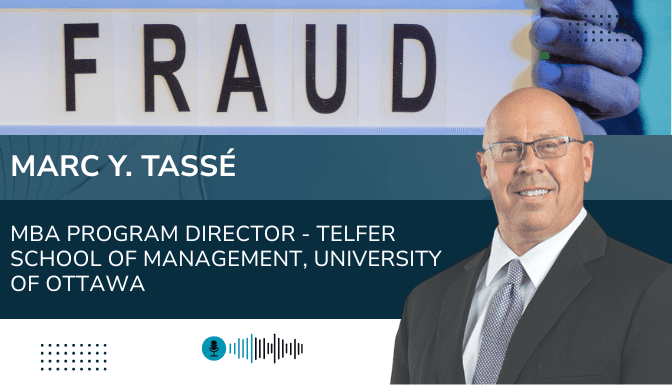
MBA Program Director - Telfer School of Management, University of Ottawa
Mr. Marc Y. Tassé is an award-winning lecturer at the University of Ottawa, where he teaches at both the Faculty of Law and the Telfer Executive MBA program. He currently serves as Senior Fellow – Board of Directors Certificate: Legal and Ethical Governance Program at the Faculty of Law – Common Law Section, and is also the Director of the MBA Program at the Telfer School of Management. Over the past 35 years, Mr. Tassé has taught more than 10,000 students in law and business programs, and has trained over 60,000 legal and business professionals across Canada and internationally. He has also designed and delivered numerous accredited professional development programs and created innovative courses for both Law and MBA students. A recognized expert in economic and financial crime, Mr. Tassé explores domestic and transnational misconduct by examining what drives individuals to break the law, how illicit activities are concealed, and what measures can be taken to disrupt these schemes. His work places a strong emphasis on the use of Artificial Intelligence, Data Analytics, and Machine Learning to enhance the prevention and detection of fraud and corruption. As a thought leader in the field of anti-corruption, Mr. Tassé was selected as a knowledge partner at the 2020 OECD Global Anti-Corruption & Integrity Forum, where he presented his research paper on “Re-imagining Corporate Punishment on a Multilateral Scale.” He was subsequently invited to present further research on supranational anti-corruption mechanisms at a symposium jointly hosted by the World Bank Office of Suspension and Debarment, the OECD, and the American Society of International Law in April 2022. In 2020, Mr. Tassé also participated in academic roundtable discussions convened by the United Nations Office on Drugs and Crime (UNODC) to advise the G20 Anti-Corruption Ministerial Working Group. His current research examines the impact of corruption allegations and financial misreporting on the market capitalization of publicly traded companies. He is also actively engaged in the study of class action litigation trends related to white-collar and corporate crime, and the reputational risks faced by corporations and their boards. Mr. Tassé is a Fellow Chartered Professional Accountant (FCPA), and a Fellow Chartered Governance Professional (FCG). In recognition of his significant contributions to his field, Mr. Tassé was awarded the King Charles III Coronation Medal.
Provincial regulators of CPAs in Canada do not require that independent providers of CPD be approved to offer courses. Instead, individual CPAs are responsible for assessing whether a CPD activity meets their requirements, and may take activities from any source provided those requirements are met.
Every course offered on LearnFormula is delivered by a qualified subject matter expert or learning organization, and advances learning objectives that are relevant to the responsibilities or professional competencies of Canadian CPAs. All activities on LearnFormula are quantifiable in terms of hours, and are also verifiable, in that users receive documented evidence of their attendance via a certificate of completion after finishing a course (and this certificate is stored by LearnFormula indefinitely). Nearly 100,000 Canadian CPAs successfully satisfy their CPD requirements via LearnFormula on an annual basis.
