Human Capital Assessment in Chaotic Economic Climate « Survive or Thrive »
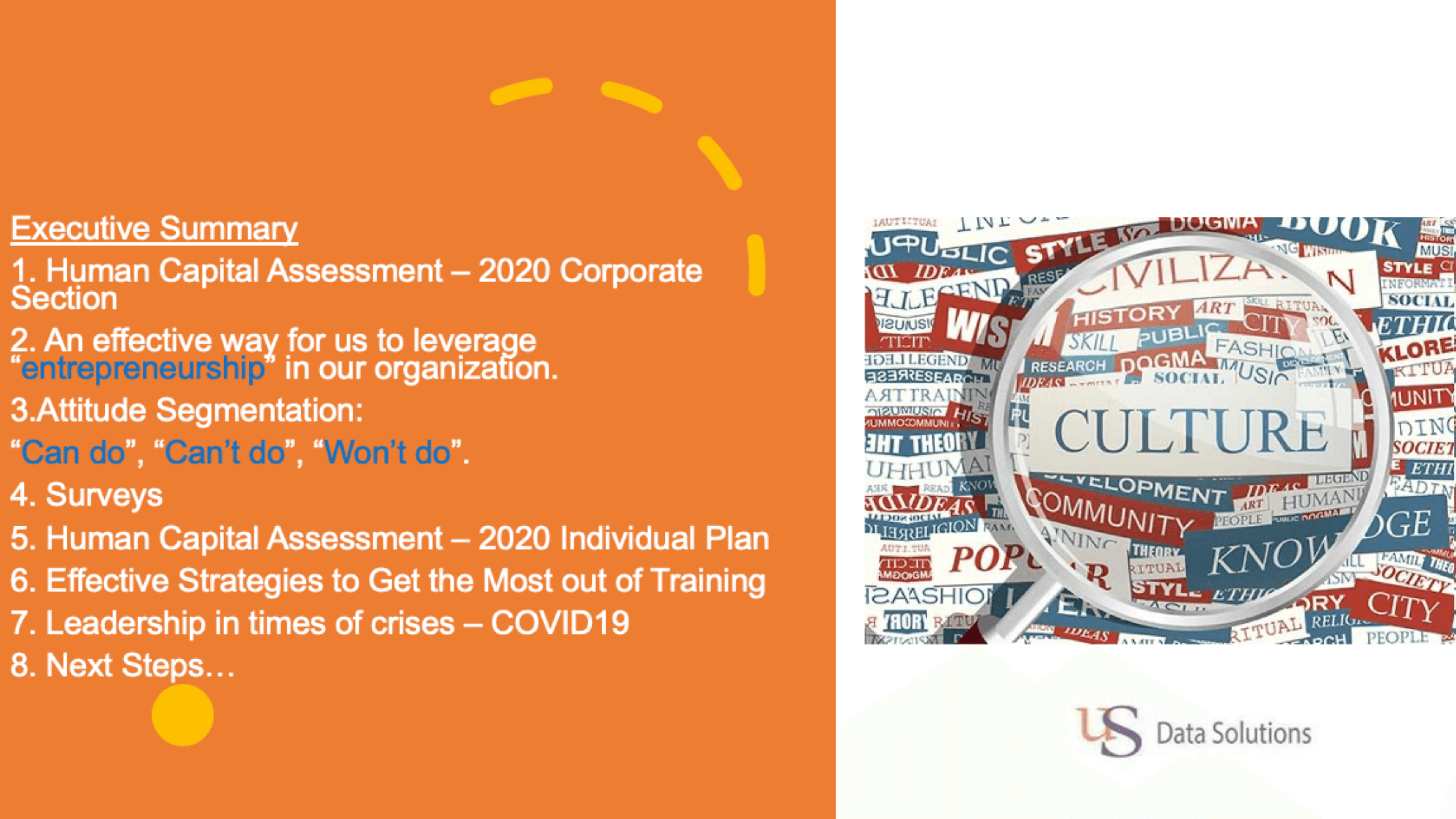
The rapid pace of change is outstripping our ability to respond in a timely and effective manner. The world is being transformed by technical advances that are turning business models upside down. There is more uncertainty, complexity, and ambiguity than ever before. Workers are asserting their independence and looking for work that is meaningful. Large organizations are struggling to keep their competitive edge. Products and services are maturing or are at the end of their life cycles. Organizational structures, practices, and processes that worked in the past are no longer effective. Leaders that were successful in the past are not adequately prepared for the future. Few organizations are prepared to develop, support, and sustain innovation growth over time. All these issues are putting pressure on organizations to become more entrepreneurial. That is why organizations are turning to corporate entrepreneurship or intrapreneurship to transform their cultures to be more entrepreneurial. The top 100 most innovative companies use human capital assessment to improve their ability to innovate and increase financial performance. These organizations have higher levels of productivity, employee engagement, growth, and profitability.

Auditing, Compliance, Project Management, Supply Chain, Corporate Training
Sulaiman Afzal, FCA Ph: 734-474-3475 / sulaimanafzal@gmail.com Auditing, Compliance, Project Management, Supply Chain, Corporate Training Sulaiman Afzal is a fellow of the Institute of Chartered Accountants in England & Wales (ICAEW) and a fellow of ICAP. He has over 30 years of domestic and international experience ranging from healthcare (BCBSIL), public accounting (KPMG, Ernst & Young), Commercial and Investment Banking (The National Commercial Bank and Morgan Stanley) and automotive industry (Visteon). Mr. Afzal is currently based in the United States. Mr. Afzal has been involved in US publically-owned corporations which are subject to the auditing and reporting requirements of the US Sarbanes Oxley Law, US Foreign Corrupt Practices Act (FCPA) and Supply Chain risk management process. Mr. Afzal’s research has recognized that controls are designed to manage risks, detect and prevent errors, and ensure compliance. His research shows that the existing internal control systems are costly due to reliance on manual controls and nonstandard automated controls. Mr. Afzal focuses on helping multi-national corporations implement automated controls which are 24/7 for global anti-corruption and anti-bribery in supply chain management by applying Continuous Controls Monitoring (CCM). Mr. Afzal is a Certified Six Sigma Green Belt and a member of XII Inc. (XBRL). Mr. Afzal’s Thought Leadership: Conducted research for establishing anti-corruption/anti-bribery framework in emerging markets. Led Anti-Corruption, Anti-Bribery workshops in Beijing and in Las Vegas. Panelists included attorneys. Published article on Compliance Audits – Peace of Mind – Audit Committees.
Provincial regulators of CPAs in Canada do not require that independent providers of CPD be approved to offer courses. Instead, individual CPAs are responsible for assessing whether a CPD activity meets their requirements, and may take activities from any source provided those requirements are met.
Every course offered on LearnFormula is delivered by a qualified subject matter expert or learning organization, and advances learning objectives that are relevant to the responsibilities or professional competencies of Canadian CPAs. All activities on LearnFormula are quantifiable in terms of hours, and are also verifiable, in that users receive documented evidence of their attendance via a certificate of completion after finishing a course (and this certificate is stored by LearnFormula indefinitely). Nearly 100,000 Canadian CPAs successfully satisfy their CPD requirements via LearnFormula on an annual basis.
