
search
Why standard email platforms fail your professional duty of confidentiality and how to fix it.
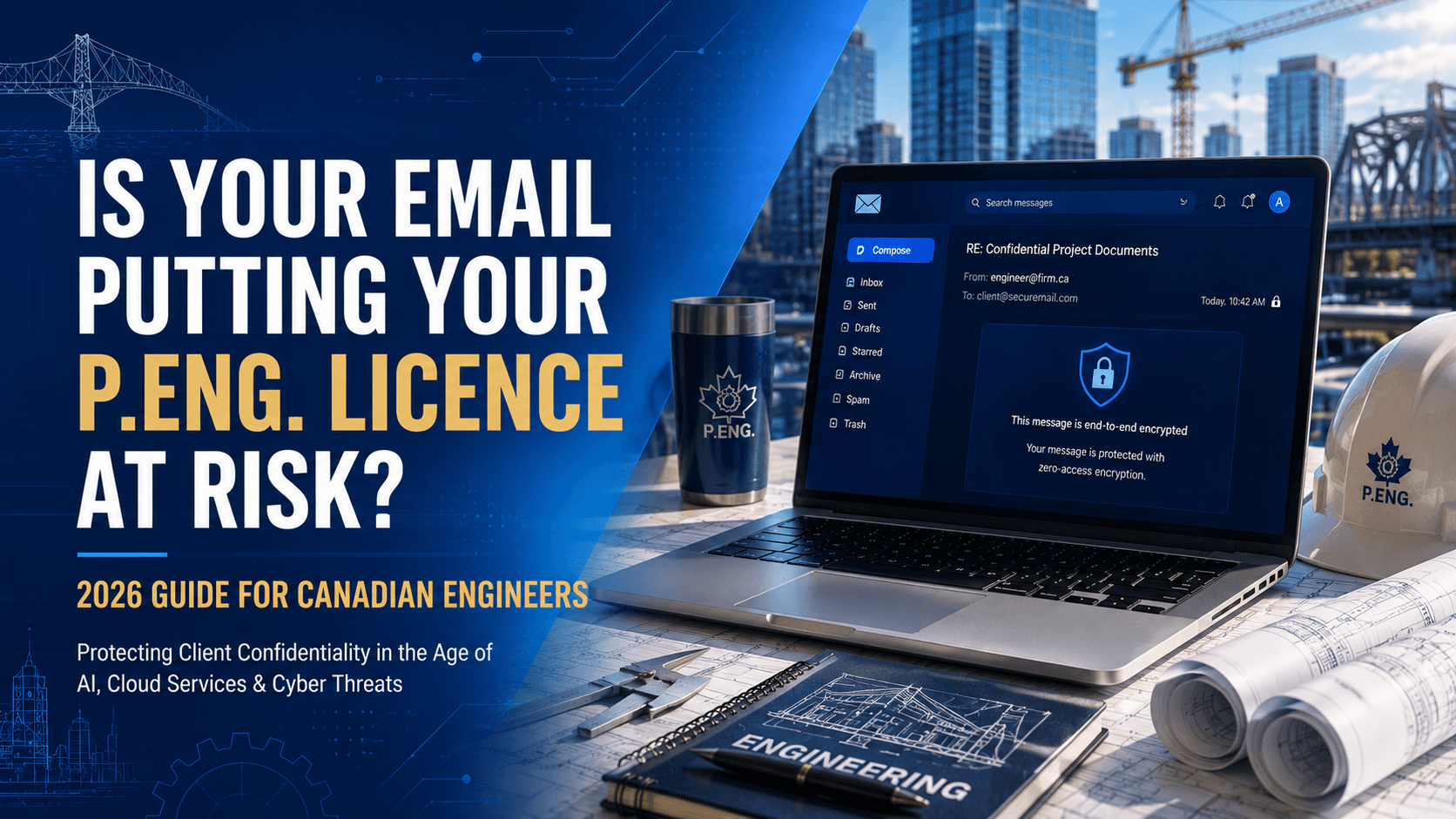
Email, Confidentiality, and the Professional Seal: A Data-Protection Review for Canadian Engineers
Every professional engineer in Canada carries a seal, and with it individual accountability for the work and for everything surrounding it, including how a client's confidential information is protected. Most engineers think about that obligation in terms of what they say and who they talk to. Few have examined the email platform carrying that information, or what it means that the company running that platform holds a key to every message. This course examines that gap and what it means for professional practice.
Email is where confidential technical work actually moves. Design files, site assessments, bid strategies, and client approvals all travel by email, which makes the email platform the primary channel for the most professionally sensitive work an engineer produces. The course begins by inventorying what is really in an engineer's inbox, from tender data and client specifications to geotechnical reports, failure analyses, and candid pre-submission drafts, and connects each category to the confidentiality duty in the PEO Code of Ethics.
From there it builds an evidence-based case. It explains how standard email encryption works and why Google and Microsoft, as American companies, hold the decryption keys to every inbox and can be compelled under the US CLOUD Act to produce stored data without a Canadian court order and without notice to the engineer or client. It reviews the Canadian Centre for Cyber Security's findings on state-sponsored theft of commercially sensitive data in sectors where Canadian engineers work, along with documented breach cases and the AI-driven rise in email compromise. It sets out the regulatory consequences under PIPEDA and Quebec's Law 25, and the professional standard-of-care exposure through the PEO complaints process. It then introduces end-to-end encryption with zero-knowledge architecture, compares three platforms on data access, legal jurisdiction, and cost, and provides a step-by-step migration path for practices that decide to act, including account recovery setup and documenting the decision.
This course is designed for sole consultants, small and midsize engineering firms, and any licensed engineer responsible for how confidential client information is handled. No technical background is required.
Learning objectives
By the end of this course, participants will be able to:
Try Proton Mail free for 14 days — no credit card required. Get started here: https://now.getproton.me/hrfjs8infz4q-o3hzta

Professional online education for engineers and technical professionals
Engineering Education Group provides online professional development and continuing education courses for engineers, technical professionals, and industry practitioners. Our programs focus on practical skills, technical knowledge, industry standards, and lifelong learning through flexible and accessible online education.
Provincial regulators of CPAs in Canada do not require that independent providers of CPD be approved to offer courses. Instead, individual CPAs are responsible for assessing whether a CPD activity meets their requirements, and may take activities from any source provided those requirements are met.
Every course offered on LearnFormula is delivered by a qualified subject matter expert or learning organization, and advances learning objectives that are relevant to the responsibilities or professional competencies of Canadian CPAs. All activities on LearnFormula are quantifiable in terms of hours, and are also verifiable, in that users receive documented evidence of their attendance via a certificate of completion after finishing a course (and this certificate is stored by LearnFormula indefinitely). Nearly 100,000 Canadian CPAs successfully satisfy their CPD requirements via LearnFormula on an annual basis.