
search
A Practical Guide to AI Risk, Controls, and Audit Testing
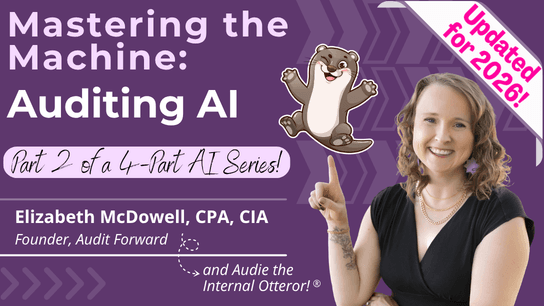
Artificial intelligence is creating new opportunities for organizations, but it is also introducing new risks that internal auditors need to understand. Updated for 2026, this course incorporates current AI risk themes, recent news examples, and practical control considerations for today’s rapidly evolving AI environment.
This course helps auditors move beyond AI buzzwords and focus on the practical audit questions that matter: where AI is being used, what risks it creates, what controls should be in place, and how those controls can be tested.
Participants will explore key AI risk categories, including governance, inventory and use cases, data protection and privacy, model performance and reliability, bias and fairness, transparency, cybersecurity and AI misuse, and third-party and embedded AI. The course also connects those risks to specific internal controls and testing procedures, giving auditors a practical framework for evaluating whether AI safeguards are designed appropriately and operating effectively.
By the end of the course, participants will be better prepared to assess AI use cases, identify red flags, ask stronger audit questions, and provide meaningful assurance over AI-related risks without needing to become AI engineers.

Audit Smarter, not Harder - with Elizabeth and Audie the Internal Otteror!
Elizabeth McDowell, CPA, CIA has over 20 years of audit experience and is the founder of Audit Forward, an innovative internal audit consulting and training firm. Elizabeth is passionate about advancing and advocating for the internal audit profession and was recognized as one of the 2023 Internal Audit Beacons by Richard Chambers. Elizabeth makes auditing and training fun (no, really!) with the help of her mascot, Audie the Internal Otteror. Elizabeth’s most recent industry experience was at Achieve, where she was Sr. Director, Audit Strategy; prior to that, she held internal audit leadership roles at Elevations Credit Union, Fidelity Investments, and Xcel Energy after first starting her career at Ernst & Young.
Provincial regulators of CPAs in Canada do not require that independent providers of CPD be approved to offer courses. Instead, individual CPAs are responsible for assessing whether a CPD activity meets their requirements, and may take activities from any source provided those requirements are met.
Every course offered on LearnFormula is delivered by a qualified subject matter expert or learning organization, and advances learning objectives that are relevant to the responsibilities or professional competencies of Canadian CPAs. All activities on LearnFormula are quantifiable in terms of hours, and are also verifiable, in that users receive documented evidence of their attendance via a certificate of completion after finishing a course (and this certificate is stored by LearnFormula indefinitely). Nearly 100,000 Canadian CPAs successfully satisfy their CPD requirements via LearnFormula on an annual basis.