Transform outdated annual reviews into agile, continuous feedback systems that inspire peak employee engagement and drive measurable business results.
Traditional performance management has evolved from annual appraisal and ratings towards continuous feedback and AI-enabled processes. But improving the process alone does not necessarily improve performance.
This session takes a broader view, exploring the architecture that sits beneath effective performance and workforce decisions. It starts with clear roles, accountabilities and expectations, distinguishing ongoing performance expectations from time-bound goals and recognising the multidimensional nature of performance.
From there, we examine how role requirements translate into capability and competency frameworks; how proficiency, assessment and appropriate evidence establish what people can do; and why competence, training completion and actual job performance need to remain distinct.
The session then shows how connected evidence supports meaningful feedback, targeted development and defensible performance decisions — and how the same architecture can extend beyond the current role to support career pathways, role matching, internal mobility, succession and workforce readiness.
Throughout, the emphasis is on maintaining clear distinctions between performance, competence, potential and readiness while connecting the information needed for better people decisions and stronger organizational assurance.

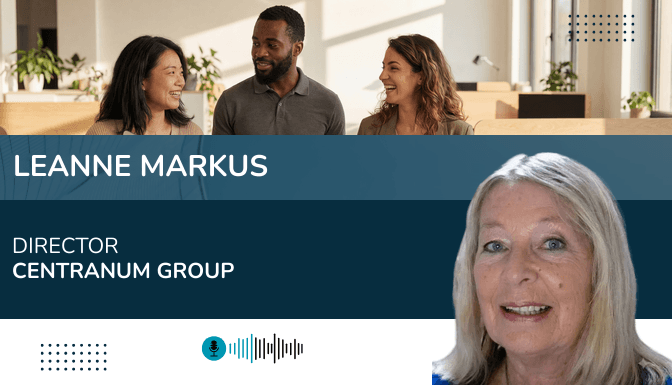
Director | Centranum Group
Leanne Markus is a registered psychologist, Principal of Performance Group International, Consulting Organisational Psychologists, founder and CEO of Centranum. At Centranum she leads the team in the configuration and deployment of our customizable competency, performance and talent management platforms for clients around the world. Leanne has held senior operational roles in retail, service and manufacturing organisations internationally. Since the establishment of Performance Group in 1993 she has been involved in OD consulting, completing projects across a broad range of industries. She has guest lectured in Psychology, and related Business, HR and IT topics at a number of universities. Her perspective on Human Capital and Organizational Development is grounded in the combination of her business experience and professional training. An advocate of evidence based practice she maintains an in depth knowledge of research in the field of Industrial and Organisational Psychology, using it to inform best practice in HR practice and the development of Centranum’s supporting technology. Her particular area of specialization is competency based management for knowledge intensive organisations. She is the author of several papers and articles on HR systems and work force competencies, and is a speaker at industry and academic conferences internationally.
Provincial regulators of CPAs in Canada do not require that independent providers of CPD be approved to offer courses. Instead, individual CPAs are responsible for assessing whether a CPD activity meets their requirements, and may take activities from any source provided those requirements are met.
Every course offered on LearnFormula is delivered by a qualified subject matter expert or learning organization, and advances learning objectives that are relevant to the responsibilities or professional competencies of Canadian CPAs. All activities on LearnFormula are quantifiable in terms of hours, and are also verifiable, in that users receive documented evidence of their attendance via a certificate of completion after finishing a course (and this certificate is stored by LearnFormula indefinitely). Nearly 100,000 Canadian CPAs successfully satisfy their CPD requirements via LearnFormula on an annual basis.
