Protect your cash flow and avoid costly delays by mastering Ontario's strict prompt payment rules and navigating the rapid adjudication process with confidence.
The "pay now, argue later" philosophy of the Construction Act is undergoing its most significant evolution since 2018. With the Bill 216 amendments taking full effect on January 1, 2026, the administrative burden is shifting, and the stakes for non-compliance have never been higher.
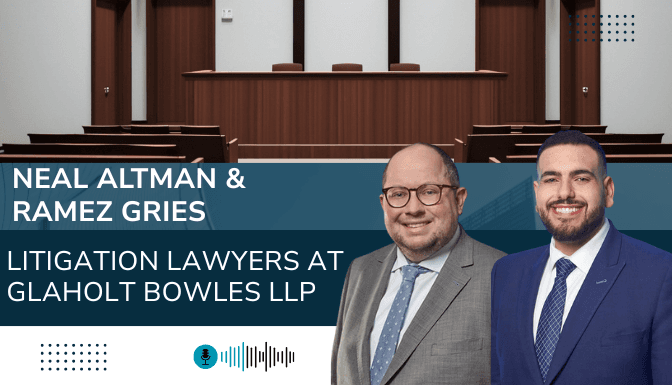
Join experts Neal Altman and Ramez Gries for a practical, one-hour deep dive into the mechanics of the 2026 regime. We’ll move beyond theory to help you navigate the new 7-day invoice deeming rule, the end of holdback set-off, and the expanded jurisdiction of private adjudicators. Whether you are advising owners on risk allocation or helping subcontractors secure overdue payments, this webinar provides the strategic roadmap necessary to keep the payment cascade flowing. Don't let your clients be the test case for a jurisdictional waiver—learn how to preserve rights in an era of 90-day windows and mandatory annual releases.

Partner | Glaholt Bowles LLP
Neal is an experienced litigator, who is committed to helping clients achieve their goals through effective and creative advocacy. While his practice focuses on construction litigation, Neal has represented clients in corporate, commercial, real estate, and construction disputes, and has appeared before numerous courts and tribunals including the Ontario Superior Court of Justice, Ontario Superior Court of Justice (Divisional Court), Ontario Court of Appeal, Local Planning Appeal Tribunal, Landlord and Tenant Board, and Human Rights Tribunal of Ontario. In addition to advocacy, Neal places a strong emphasis on alternative dispute resolution, and has significant experience in negotiating favourable settlements for clients at mediation and in other forums. Neal graduated from Western University in 2014 with an Honours Specialization in Political Science, subsequently obtaining his Juris Doctor from Osgoode Hall Law School in 2017. Neal was called to the Bar of Ontario in 2018. Outside of the office, Neal is an avid fan of the Toronto Maple Leafs, Raptors, and Blue Jays, and spends his time attending concerts, travelling, and playing golf.

Associate | Glaholt Bowles LLP
Ramez assists clients and senior counsel in navigating a wide range of construction and infrastructure disputes. His practice includes both traditional litigation and alternative dispute resolution, with experience in lien, delay, and deficiency claims, as well as surety and performance bond matters. Ramez has acted on files representing owners, general contractors, and consultants in litigation, arbitrations, and mediations. Drawing on his business background, he provides pragmatic, results-oriented advice that balances legal and strategic considerations. Ramez earned his Juris Doctor from Osgoode Hall Law School, where he held several leadership roles and served as a Dean’s Fellow.
Provincial regulators of CPAs in Canada do not require that independent providers of CPD be approved to offer courses. Instead, individual CPAs are responsible for assessing whether a CPD activity meets their requirements, and may take activities from any source provided those requirements are met.
Every course offered on LearnFormula is delivered by a qualified subject matter expert or learning organization, and advances learning objectives that are relevant to the responsibilities or professional competencies of Canadian CPAs. All activities on LearnFormula are quantifiable in terms of hours, and are also verifiable, in that users receive documented evidence of their attendance via a certificate of completion after finishing a course (and this certificate is stored by LearnFormula indefinitely). Nearly 100,000 Canadian CPAs successfully satisfy their CPD requirements via LearnFormula on an annual basis.
