Connect Power BI Desktop to text files, Excel, folders, SharePoint, the web and SQL Server, then clean and reshape the data with Power Query.
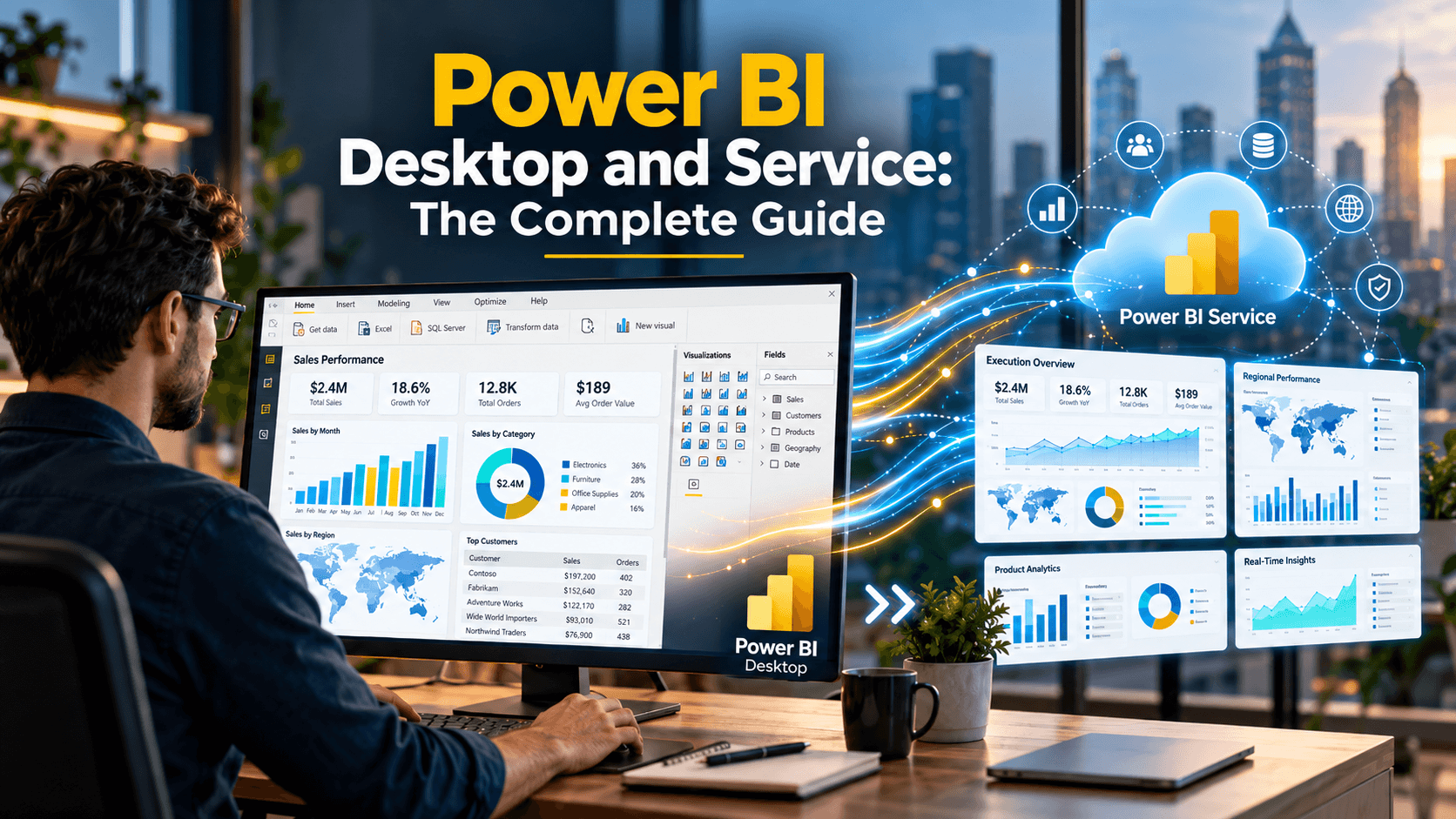
Most of the work in any Power BI project happens before a single chart is drawn: getting the data in, and getting it into shape. This course, Part 1 of a three-part Power BI series, teaches you to do both with confidence in Power BI Desktop and Power Query.
You will connect to every common business data source, then learn the Power Query techniques that turn messy, system-generated data into clean tables ready for modelling. The course is hands-on throughout: every file used in the videos is supplied, each section opens with an overview and closes with a summary, and Quick Practice lessons let you apply each technique straight away. An interactive PDF workbook accompanies the course.
What you will cover:
Who this course is for:
The Power BI series:
Part 1: Connecting to and Transforming Data with Power Query (this course)
Part 2: Data Modelling and DAX
Part 3: Reports, Dashboards and the Power BI Service

CEO of AI Awareness Limited | 25+ years in IT training | Helping non-technical professionals go from AI-curious to AI-confident
Grant Gamble has spent over 25 years in IT and technology training, working with businesses across the UK on practical AI adoption. He is CEO of AI Awareness Limited and founder of G Com Solutions Limited, and specialises in helping non-technical professionals move from AI-curious to AI-confident through hands-on, domain-specific training and certification. Grant's view is that AI is not a single tool but a set of capabilities spread across every department, often underused or ungoverned. The organisations making real progress are not the ones running generic awareness programmes; they are the ones mapping specific AI capabilities to specific workflows and giving their people the time and permission to use them. His courses take exactly that approach. His teaching covers practical AI literacy for non-technical professionals, AI skills and workforce readiness, and the governance and responsible use of AI at work. Expect a hands-on style: real business examples, clear explanations of why each technique works, and skills you can apply to your own work straight away.
Provincial regulators of CPAs in Canada do not require that independent providers of CPD be approved to offer courses. Instead, individual CPAs are responsible for assessing whether a CPD activity meets their requirements, and may take activities from any source provided those requirements are met.
Every course offered on LearnFormula is delivered by a qualified subject matter expert or learning organization, and advances learning objectives that are relevant to the responsibilities or professional competencies of Canadian CPAs. All activities on LearnFormula are quantifiable in terms of hours, and are also verifiable, in that users receive documented evidence of their attendance via a certificate of completion after finishing a course (and this certificate is stored by LearnFormula indefinitely). Nearly 100,000 Canadian CPAs successfully satisfy their CPD requirements via LearnFormula on an annual basis.
