Why standard email platforms are a master key for hackers and how to secure your practice's financial identity.
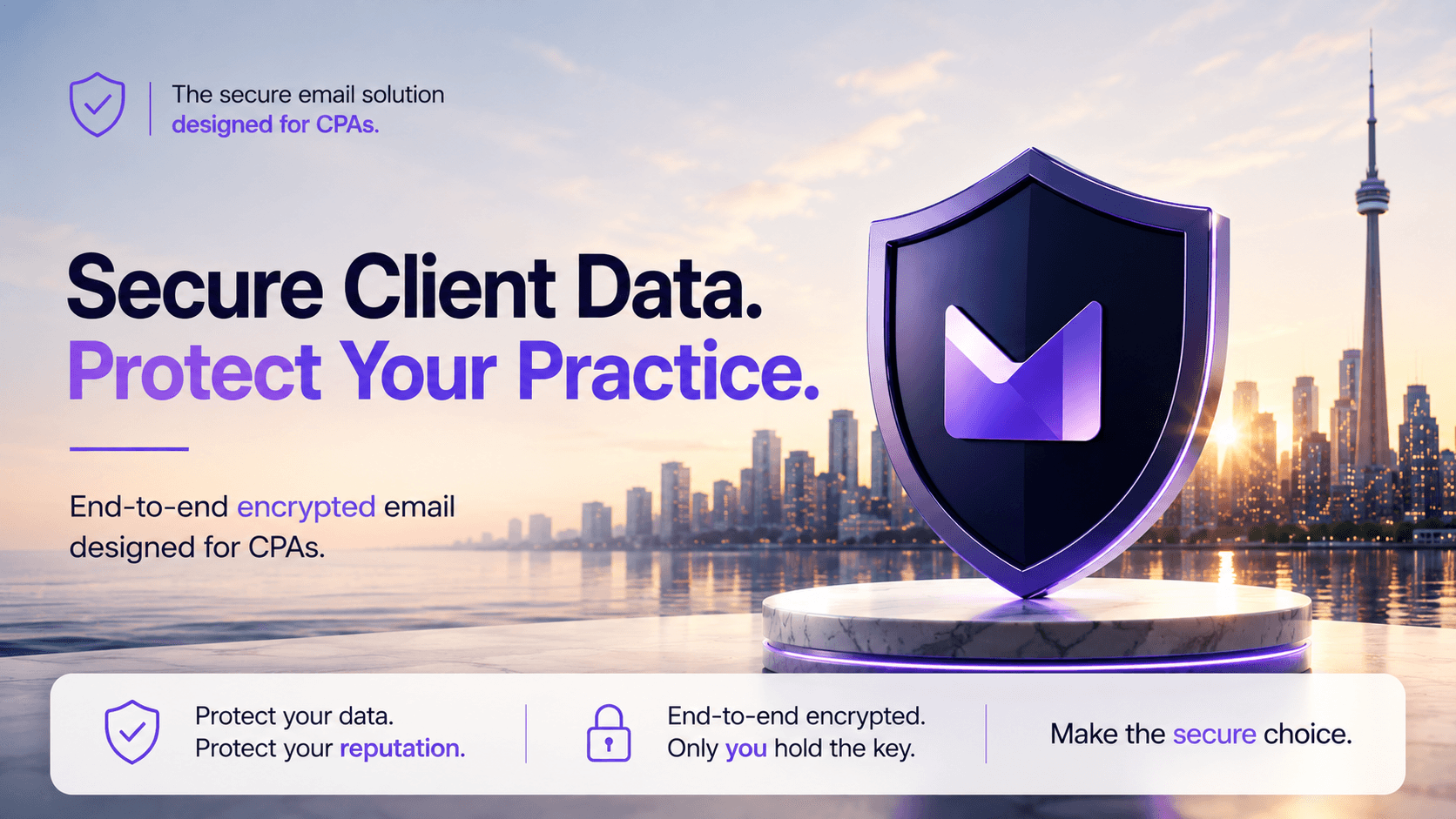
Most data breaches don't start with sophisticated cyberattacks. They start with a single email, clicked by one person, on an otherwise ordinary Tuesday. For a CPA practice, that one click sits in front of an inbox containing T1 returns, Social Insurance Numbers, RRSP histories, family business financials, and complete financial identities — protected by infrastructure that was never designed to keep them private. This course examines the email security gap most Canadian CPAs don't know they have, explaining what "encrypted" actually means on Gmail and Outlook, why both platforms leave client data legally accessible to US authorities under the CLOUD Act, and what the documented pattern looks like when things go wrong.
It also presents the solution: end-to-end encrypted email built on zero-knowledge architecture, available at entry-level pricing identical to Gmail, with setup that takes approximately one hour and leaves the email address, Outlook, and existing workflows unchanged. The course covers the full platform comparison — Google Workspace, Microsoft 365, and Proton Mail — across provider access, data jurisdiction, and cost, and provides a step-by-step decision framework tied to PIPEDA, Law 25, and the CPA Code of Professional Conduct. Every question that matters gets a specific answer, with the numbers, the comparison, and a clear process to act on it.
Learning Objectives
By the end of this course, participants will be able to:
Ready to make the switch? Start your free 14-day trial here: https://now.getproton.me/hrfjs8infz4q-o3hzta
Online Learning for Modern Accountants
Accounting Education Group provides online professional development and continuing education courses for accounting, bookkeeping, tax, and finance professionals. Our training is designed to support ongoing learning through practical, relevant, and accessible educational content that helps professionals maintain and expand their knowledge in an evolving business environment.
Provincial regulators of CPAs in Canada do not require that independent providers of CPD be approved to offer courses. Instead, individual CPAs are responsible for assessing whether a CPD activity meets their requirements, and may take activities from any source provided those requirements are met.
Every course offered on LearnFormula is delivered by a qualified subject matter expert or learning organization, and advances learning objectives that are relevant to the responsibilities or professional competencies of Canadian CPAs. All activities on LearnFormula are quantifiable in terms of hours, and are also verifiable, in that users receive documented evidence of their attendance via a certificate of completion after finishing a course (and this certificate is stored by LearnFormula indefinitely). Nearly 100,000 Canadian CPAs successfully satisfy their CPD requirements via LearnFormula on an annual basis.
